
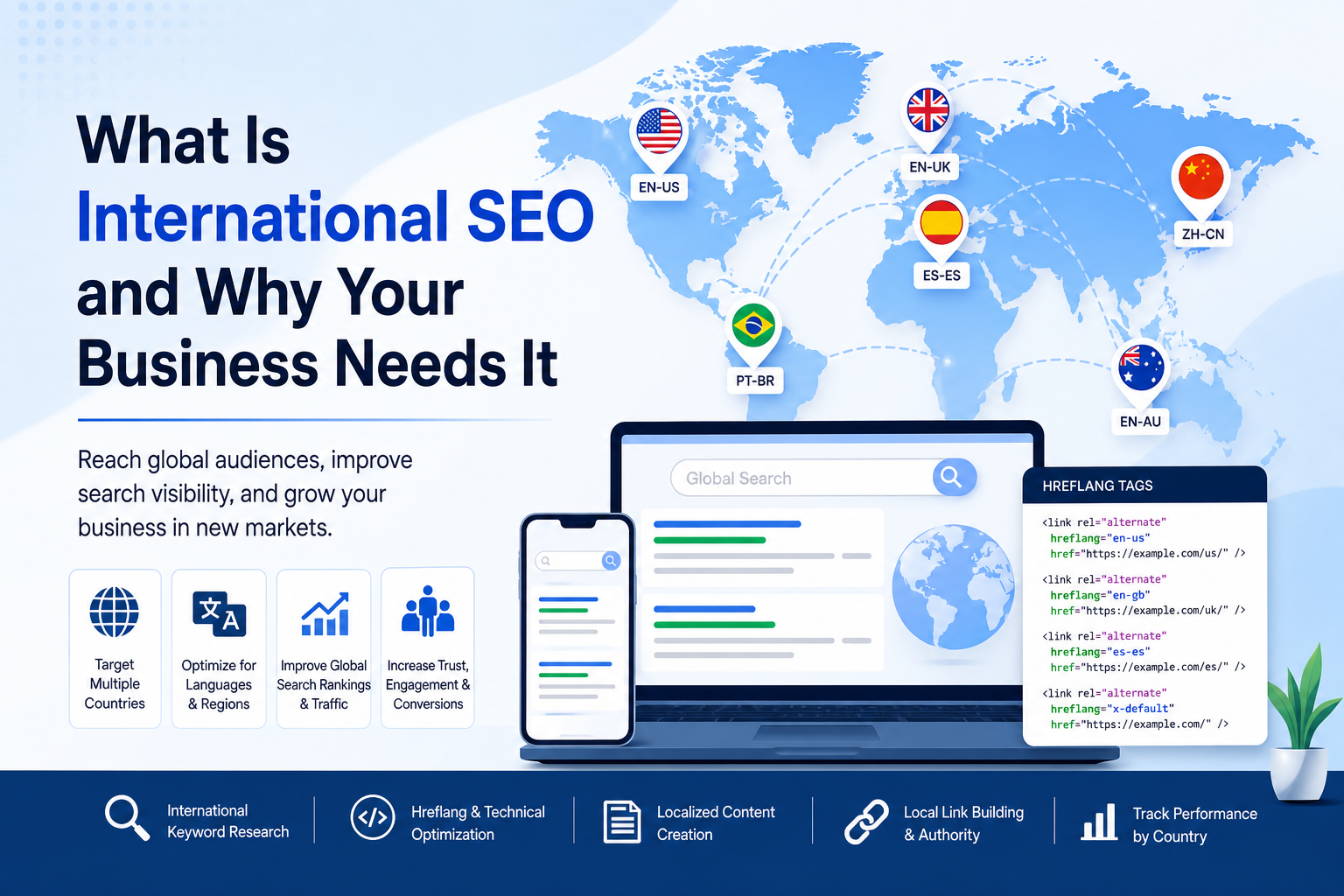
Expanding into global markets is exciting, but reaching international customers takes more than translating your website. People in different countries search differently, use different terms, trust different platforms, and expect content that feels local to them. That is where international SEO becomes essential.
International SEO is the process of optimizing your website so search engines can understand which countries, languages, and regions your content is meant to target. It helps your business appear in front of the right audience in the right location, whether you want to reach customers in the United States, United Kingdom, Canada, Australia, Europe, Asia, or multiple global markets.
For businesses that want to grow beyond one country, international SEO can improve global search visibility, attract qualified traffic, reduce duplicate content issues, and create a better user experience for international visitors. Google’s own documentation explains that multilingual and multi-regional websites should help search engines understand localized versions of pages so users can be directed to the most appropriate page by language or region.
What is International SEO?
International SEO is a strategy used to optimize a website for multiple countries, languages, or regions. It helps search engines identify:
Which country your page is targeting
Which language your content is written in
Which version of a page should appear for a specific user
How your international pages relate to one another
Whether your business serves one market, multiple regions, or global audiences
For example, a business may need separate pages for English-speaking users in the United States, the United Kingdom, Canada, and Australia. Even though these audiences speak the same language, they may use different words, currencies, spellings, buying habits, and search intent.
A strong international SEO strategy does not simply copy one page and translate it into another language. It adapts keywords, content, technical structure, local signals, and user experience for each market.
Why International SEO Matters for Global Business Growth
If your business wants to attract customers outside your home country, international SEO gives your website a structured way to compete in global search results.
Without it, search engines may not know which version of your content to show. A visitor in Germany might land on your U.S. page. A Spanish-speaking user may see an English page. Two similar pages may compete with each other instead of supporting one another. These issues can reduce rankings, traffic, and conversions.
International SEO helps solve these problems by aligning your website with local search behavior, technical requirements, and regional user expectations.
Key Benefits of International SEO
1. Reach Customers in Multiple Countries
International SEO allows your website to target users in different markets instead of depending only on one country. This is especially valuable for ecommerce brands, SaaS companies, travel businesses, B2B service providers, manufacturers, agencies, and companies offering global services.
By creating country-specific or language-specific pages, your business can appear in search results where your target customers are actively looking.
2. Improve Global Search Visibility
Search visibility changes from country to country. A keyword that performs well in one market may have very low search demand in another. International SEO helps your business identify the right keywords for each region instead of relying on direct translation.
For example, users in the United States may search for “international SEO services,” while users in another country may search using different phrasing, local spelling, or language-specific terms.
3. Deliver a Better User Experience
Users are more likely to trust and engage with a website that feels relevant to their location. Localized content can include regional spelling, local currency, familiar examples, cultural references, local testimonials, market-specific offers, and region-specific calls to action.
This improves the user experience and can increase conversions because visitors feel that the business understands their needs.
4. Avoid Duplicate Content and Wrong-Page Ranking Issues
When businesses create similar pages for different countries or languages, search engines need clear signals to understand how those pages are connected. Google recommends using hreflang to tell Search about localized versions of a page, especially when content has regional variations or is translated into multiple languages.
Correct hreflang implementation helps search engines show the right page version to the right audience.
5. Build Trust in Local Markets
International SEO also includes local authority building. This may involve earning backlinks from relevant websites in target countries, creating locally useful content, building market-specific landing pages, and optimizing for regional search expectations.
The more relevant your website appears to a local audience, the easier it becomes to build credibility and compete against local competitors.
International SEO vs Local SEO
International SEO and local SEO are related, but they are not the same.
Local SEO focuses on ranking in a specific city, area, or local service region. It is ideal for businesses such as restaurants, clinics, repair services, real estate agencies, or local stores.
International SEO focuses on reaching audiences across different countries, languages, or global regions. It is ideal for businesses that want to expand into new markets or serve customers internationally.
For example, a local SEO strategy might target “SEO agency in Singapore,” while an international SEO strategy might target “SEO services for global businesses,” “international SEO agency,” or country-specific service pages for the U.S., UK, Canada, and Australia.
How International SEO Works
International SEO works by combining market research, keyword research, technical SEO, content localization, and authority building.
A successful strategy usually includes:
International market research
Country-specific keyword research
Website structure planning
Hreflang implementation
Localized content creation
Technical SEO improvements
International link building
Local search behavior analysis
Conversion optimization for each market
Performance tracking by country and language
Search Engine Land’s international SEO guidance also highlights that global SEO success requires more than technical setup; execution must reflect local search behavior, authority signals, and cultural user expectations.
Best Practices for International SEO
1. Choose the Right International Website Structure
Your website structure helps search engines and users understand which market each page targets. The most common options include:
Country-code top-level domains: example.co.uk, example.ca
Subdomains: uk.example.com, ca.example.com
Subdirectories: example.com/uk/, example.com/ca/
For many businesses, subdirectories are easier to manage because all international pages remain under one main domain. However, the best choice depends on your business goals, resources, technical setup, and target markets.
2. Use Hreflang Tags Correctly
Hreflang tags tell search engines which language or regional version of a page should be shown to users. Google says you can indicate alternate localized pages using HTML tags, HTTP headers, or sitemaps.
For example, if you have pages for U.S. English, UK English, and Spanish, hreflang helps Google understand which version should appear for each audience.
A basic hreflang setup may include:
en-us for English users in the United Statesen-gb for English users in the United Kingdomes-es for Spanish users in Spainx-default for users who do not match a specific language or region
Hreflang errors are common, so each language version should reference itself and the other alternate versions correctly.
3. Do International Keyword Research
Do not rely on direct translation. Keywords should be researched separately for each market.
A phrase that works in one country may not match how people search in another. International keyword research should consider:
Search volume by country
Local keyword variations
Language differences
Buyer intent
Competitor rankings
Local slang or terminology
Currency and product naming differences
Search engine preferences
This ensures your content targets the terms people actually use in each market.
4. Localize Content, Don’t Just Translate It
Translation changes words. Localization adapts the message.
Strong localized content includes local examples, regional pain points, cultural context, local spelling, local measurements, currency, and market-specific calls to action.
For example, a page targeting the United States may mention dollars, U.S. shipping expectations, and American spelling. A page targeting the United Kingdom may use pounds, UK spelling, and examples relevant to that audience.
5. Optimize Technical SEO for Global Users
International visitors may access your website from different locations, devices, and network speeds. Technical SEO is important for global performance.
Key technical elements include:
Fast page loading speed
Mobile-friendly design
Clean URL structure
Proper canonical tags
XML sitemaps
Hreflang validation
Indexable localized pages
Structured data
Secure HTTPS pages
Region-friendly user experience
Google’s multi-regional site documentation confirms that multilingual and multi-regional sites can be optimized for Search when site owners provide clear signals for language and region targeting.
6. Build Local Authority With Regional Backlinks
Backlinks from relevant local websites can help strengthen your authority in a target market. For example, if your business wants to rank in Australia, links from trusted Australian websites may support your visibility in that region.
International link building can include:
Local business directories
Industry publications
Guest posts
Regional PR
Local partnerships
Country-specific resource pages
Market-specific digital campaigns
Quality matters more than quantity. Focus on relevant, trusted websites in the target region.
7. Track Performance by Country and Language
International SEO should be measured separately for each target market. A global traffic report is not enough.
Track metrics such as:
Organic traffic by country
Organic conversions by country
Keyword rankings by market
Indexed pages by language
Click-through rate by region
Bounce rate by country
Revenue or leads from each market
Hreflang and indexing issues
This helps you understand which markets are growing, which pages need improvement, and where to invest next.
Common International SEO Mistakes to Avoid
Many businesses struggle with international SEO because they expand too quickly without a clear structure. Avoid these common mistakes:
Using automatic translation without localization
Creating duplicate country pages with no meaningful differences
Forgetting hreflang tags
Using incorrect language or country codes
Blocking international pages from indexing
Redirecting users automatically based on IP without giving them a choice
Ignoring local keyword research
Using one global page for all countries
Failing to build backlinks in target markets
Not tracking performance by region
These mistakes can confuse search engines and frustrate users.
Does Your Business Need International SEO?
Your business may need international SEO if:
You sell products or services in multiple countries
You receive traffic from international visitors
You want to expand into new markets
You offer multilingual services
You serve customers across different regions
Your competitors are ranking globally
You want to increase international leads or sales
However, if your business only serves one local area and has no plans to expand, international SEO may not be necessary yet. In that case, local SEO may be a better investment.
How to Start an International SEO Strategy
Start with research before building new pages. The best process usually looks like this:
First, identify your target countries and languages.
Next, analyze search demand and competition in each market.
Then, choose the right website structure.
After that, conduct local keyword research.
Create localized content for each market.
Add hreflang tags and technical SEO signals.
Build local authority through relevant backlinks.
Track rankings, traffic, and conversions by region.
This step-by-step approach helps your business expand with a clear strategy instead of guessing.
Why Work With an International SEO Expert?
International SEO can be complex because it involves technical SEO, content strategy, localization, analytics, and market research. One mistake in hreflang, canonical tags, or URL structure can affect how your international pages rank.
Working with an experienced international SEO expert can help your business:
Choose the right market strategy
Avoid technical SEO mistakes
Create localized keyword plans
Improve international rankings
Build country-specific authority
Increase qualified global traffic
Convert international visitors into leads or customers
A professional strategy saves time and helps your business expand with confidence.
Final Thoughts
International SEO is essential for businesses that want to grow beyond one country. It helps search engines understand your global website structure, shows users the most relevant page version, and improves visibility in international search results.
The most successful global SEO strategies are built on research, localization, technical accuracy, and continuous performance tracking. Instead of simply translating content, your business should create market-specific experiences that match how people search, compare, and buy in each country.
If your business is ready to reach international customers, investing in international SEO can help you build visibility, trust, and long-term growth across global markets.
Call to Action
Want to expand your business into new countries and attract more global customers? Work with an international SEO expert who can build a customized strategy for your target markets, languages, and business goals.
FAQ Section
What is international SEO?
International SEO is the process of optimizing your website so search engines can understand which countries and languages your pages target. It helps the right users find the right version of your website in search results.
Why is international SEO important?
International SEO is important because it helps businesses reach customers in different countries, improve global search visibility, and create localized user experiences that can increase traffic, leads, and sales.
What is the difference between international SEO and local SEO?
Local SEO targets users in a specific city or local area, while international SEO targets users across multiple countries, languages, or regions.
What are hreflang tags?
Hreflang tags are technical signals that tell search engines which language or regional version of a page should be shown to users. Google recommends using them when you have multiple localized versions of a page.
Is translation enough for international SEO?
No. Translation alone is not enough. International SEO requires localization, country-specific keyword research, technical optimization, and market-specific content planning.
Which URL structure is best for international SEO?
Common international SEO URL structures include country-code domains, subdomains, and subdirectories. The best choice depends on your target markets, resources, and long-term SEO strategy.
How long does international SEO take?
International SEO is a long-term strategy. Results depend on competition, website authority, content quality, technical setup, and the number of markets being targeted.
Can international SEO help ecommerce websites?
Yes. International SEO is especially useful for ecommerce websites that sell products in multiple countries because it helps optimize product pages, category pages, currency, shipping information, and localized search visibility.